Mapacho (Wild Tobacco, Nicotiana rustica)
About the plant
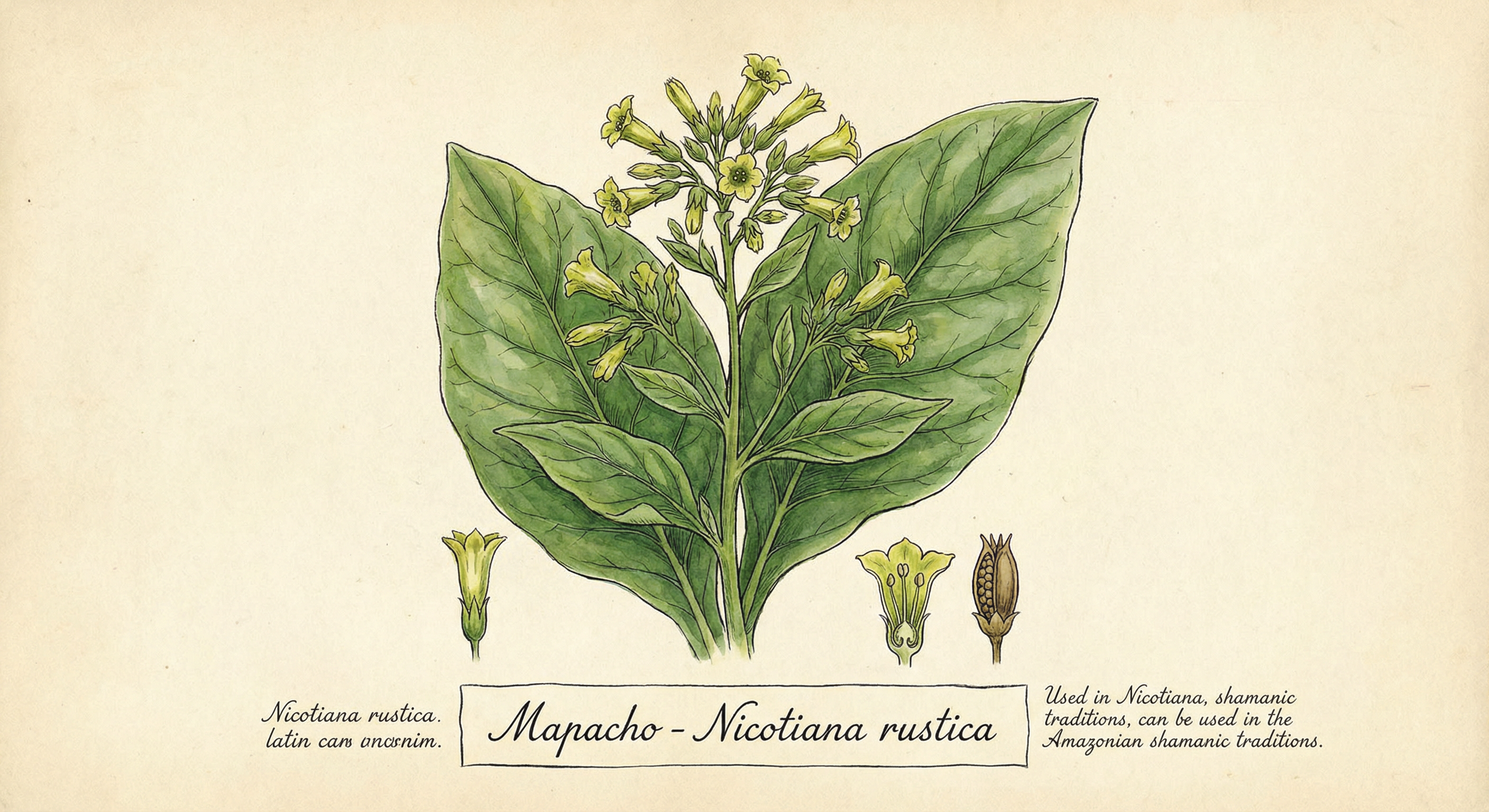
Mapacho (Latin: Nicotiana rustica) is a tobacco species in the nightshade family (Solanaceae). The plant is native to South America, particularly Peru and the Amazon basin. Before European contact, mapacho was already widely cultivated across the Americas and was the first tobacco brought to Europe — so it is this plant that began the Old World’s tobacco story, though it was later displaced in commerce by the milder Nicotiana tabacum.
An annual, branched plant up to 1.8 m tall; when cultivated outside the tropics it is usually shorter. Leaves are large, entire or slightly wavy; flowers tubular, yellowish-green, typical of nightshades. The root system is shallow but widely branched and often produces suckers. Mapacho is now grown and found as a weed in many regions: Europe, India, China, parts of Africa (Mali to Chad, Ethiopia, East and South Africa), the Caribbean, Mexico, eastern USA, Central and Western Asia, the Himalayas, Indochina, Korea — the plant has long spread far beyond its native range.
Common names: mapacho (Peru, Amazon), makhorka (Russia), thuốc lào (Vietnam), Aztec tobacco, wild tobacco, strong tobacco (English). Chemically, mapacho is far stronger than common smoking tobacco: leaves contain up to 9% nicotine versus 1–3% in N. tabacum — several times, and in some reports up to dozens of times, more potent. Because of this intensity, N. rustica was largely replaced by N. tabacum in commercial cultivation in North America; in the Amazon, the high concentration is precisely what is valued in traditional and ritual medicine.
Unlike commercial cigarettes, traditionally used mapacho contains no tar or additives: it is the raw plant, cultivated by indigenous families and curanderos for ceremony and healing. This contrast — 'tobacco as poison' in the West and 'tobacco as father of plants and medicine' in the Amazonian tradition — is key: the same species is perceived entirely differently depending on context, dose, and intention.
Properties and use
In the Amazon, mapacho is used as one of the main medicinal and ritual plants. Smoke is used to cleanse space and people before and during ceremonies; it is blown over the body (soplar) — over the crown, heart, back — to remove 'heavy' energies and restore boundaries. Tobacco is offered to fire, water, and earth as an offering and sign of gratitude. A strong tea is brewed from the leaves for deep cleansing; mapacho is a base for rapé (nasal snuff) mixed with other plants and ashes. In ayahuasca ceremonies, tobacco grounds participants and holds the space, cutting through distraction.
In the mythology of many Amazonian peoples, the tobacco spirit is called 'Father Tobacco' and honoured as one of the oldest teachers — sacred use of tobacco is estimated at three to eight thousand years. There is a tradition that the spirit of mapacho itself showed the first shamans which vines and leaves to combine to make ayahuasca. Tobacco is described as the 'king of plants' and the 'chief medicine': without it, one maestro says, 'no curandero in the world could cure.' It gives protection, discernment (the ability to tell truth from illusion), grounding, and the amplification of prayer — intention sent through tobacco is believed to reach the spirits.
Practitioners who base their practice mainly on tobacco are called maestro tabaqueros. In Peruvian tradition, tobacco is the 'chief medicinal plant' and father of all plants; among the Huni Kuin it is the 'quintessential healing substance.' Tabaqueros use it for 'problems of the mind' (anxiety, low mood, scattered attention), respiratory ailments, intestinal and skin parasites, gout, and conditions described in local epistemology as spiritual-energetic — such as harmful influence, soul loss, or fright.
The main healing form used by healers is a liquid taken orally: an infusion or maceration of the leaves. Ingestion produces pronounced changes in consciousness and strong physiological responses — nausea, vomiting; in tradition this 'purge' is seen as part of the healing process, not a side effect. For this reason, dosing, timing, and aftercare must be managed by an experienced maestro: without context and skill, the same preparation can cause poisoning.
Scientific literature is gradually documenting these practices. A transdisciplinary study (Frontiers in Pharmacology, 2020) based on interviews with a maestro tabaquero documents dosing, preparation methods, contraindications, and safety protocols. An ethnopsychological study (MDPI Plants, 2023) describes a case of ritual tobacco ingestion under a healer’s guidance for a woman with mood, anxiety, and attention disorders — with clinically significant improvement in well-being. N. rustica leaves have been found to contain pentacyclic triterpenes (betulin, oleanolic acid), phenolic acids (rosmarinic, chlorogenic), and flavonoids (luteolin, apigenin, hyperoside), which may partly explain anti-inflammatory and other traditionally attributed effects.
Use in dietas
The mapacho dieta is one of the central practices of Amazonian curanderismo. In Shipibo tradition this dieta is called 'sama': one enters a direct covenant with the plant spirit. This is not 'smoking' in the everyday sense — here tobacco acts as teacher and protector. It cleanses body and mind, grounds, gives strength, and restores connection to the earth and to other plant spirits. Many curanderos believe that without an alliance with tobacco, one cannot truly work with ayahuasca and other master plants.
Maestro tabaqueros are healers for whom tobacco is the main plant. They are respected alongside ayahuasqueros: the tobacco path is considered demanding and strict. The tobacco dieta is often described as an initiation: daily intake of mapacho maceration — for example, an infusion made from a large amount of leaves (descriptions mention figures like 200 grams of leaves per litre or more of water), with strength often increasing day by day. Body and mind undergo intense cleansing: nausea, vomiting, the stripping away of inner defences, the sense that everything unnecessary is being 'burned out.' Through this the plant 'teaches' — not by avoiding difficulty but by passing through it.
The outcome of the dieta is associated with lasting grounding and a sense of a 'shield' — the ability not to absorb others’ negativity and not to lose oneself in others’ projections. People speak of clearer boundaries, of coming back into the body, of tobacco 'putting them in their place' and giving a direct, wordless connection to the plant’s power. For those on the healer’s path, the mapacho dieta often becomes the foundation for protection and discernment: what comes from spirit and what from one’s own mind or outside influence.
Mapacho dieta is usually undertaken after some experience with ayahuasca and often other teacher plants. Duration varies: from short cycles (e.g. eight days) to several weeks or months. The conditions are those common to most dietas: abstinence from alcohol, sex, sugar, spice, salt, and rich food; from pork (sometimes the prohibition is lifelong); a simple diet — fish, green plantains, manioc, no spices or excess; isolation or strict limitation of contact so that nothing distracts from the relationship with the plant.
Among the Shipibo, a person on dieta is marked with dye from the huito (genipa) fruit on the face, hands, and feet — so that others see the sacred status and keep their distance. In ceremonies, mapacho smoke is used for soplar — blowing over the body and into space; some shamans read the patterns and direction of the smoke for diagnosis. Tobacco is considered the spirit who, according to myth, first revealed the ayahuasca recipe to shamans; in dieta, mapacho often helps break unwanted habits and addictions and gives a sense of grounding and direct contact with the plant's power — not through concepts but through the body and presence.
The experience of mapacho dieta is often described as a miniature 'death and resurrection': old identities and attachments are purged through vomiting and weakness, and in their place comes a sense of emptiness from which new clarity later grows. Many report that after the dieta their relationship to tobacco itself changes — it is no longer 'just a plant' but an ally to be called on in difficult moments. Some curanderos say that it was mapacho that taught them to hear other plants: tobacco opens the channel and holds the boundaries so that the spirits of ayahuasca, chalicoba, toé, and other teachers can speak without distortion.
If you are reading this page while considering a dieta — keep in mind that the best source is the maestro or maestra under whom you would sit. Duration, doses, combination with other plants, and whether a dieta is appropriate for your health are decided within the living tradition, not by general descriptions. Our aim is to offer context and understanding so that your conversation with the healer and with the plant itself can be informed and safe.
Precautions
Mapacho contains far more nicotine than common tobacco (up to 9% in leaves) and other alkaloids — anabasine, nornicotine. All parts of the plant are toxic if ingested in sufficient quantity. Severe nicotine poisoning is possible: nausea, vomiting, salivation, dizziness, weakness, respiratory and cardiovascular effects, and in extreme cases convulsions and collapse. Rapé based on N. rustica is very potent; even experienced users sometimes report brief dizziness and nausea; misuse or overuse carries a high risk of poisoning.
Mapacho is not suitable during pregnancy or breastfeeding, in severe cardiovascular disease, unstable blood pressure, after recent heart attack or stroke, with high sensitivity to nicotine, or in severe respiratory disease. Traditional internal use (tea, maceration) should only be undertaken under an experienced maestro tabaquero, with attention to dose, gradual increase, and contraindications. In North America N. rustica was largely replaced in mainstream cultivation by the less potent N. tabacum precisely because of these risks; in Vietnam, a single inhalation of thuốc lào (the local form of strong tobacco) often causes strong dizziness for several seconds and nausea in the unaccustomed. Sacred and medicinal use of mapacho presupposes context, intention, and knowledge — without them the plant easily turns from medicine into poison.